ARTICLES & REVIEWS
________________________________
Phillip Carpenter has reached beyond photography, applying critical material investigations to the problem of the space between things. By making negative space physical, his work endeavors to uncover the instruments of closeness, exchange, and human relationships.
– Lauren Palmor PhD
Art Historian
My favorite thing in the exhibition is a photograph printed on a flimsy sheet of white paper that looks like it slipped off the wall onto the floor. I almost stepped on it by mistake. The object in the photograph is a block of raw clay that artist Phillip Carpenter squeezed between himself and another person to make an impression of “the space between two people.” Nearby, a massive photograph of a truck faces a makeshift table supporting two lumps of unfired clay similar to the one in the image on the floor. Both lumps bear fingerprints, as well as deep grooves from having been pressed against the truck.
“The short version is, I’m interested in the spaces between things,” Carpenter told me as we were getting kicked out at the end of the opening reception at the Henry Art Gallery last Friday night. His artist statement elaborates: We shape the world with intention and also with a thoughtless human movement. ... As we set something down to pick something else up, the specifics of that placement give insight into...the shadows of our intentions, sometimes more powerful and telling than the full concentration of our objectives and intent. Carpenter is concerned with all kinds of movements, from the most calculated decisions to the metaphysics of unconscious acts. In the context of the show, his work seems to be about all these artists who are still in the midst of honing and deciphering their own relationships to objects, intentional and otherwise.
– Emily Pothast
CityArts Magazine
Among the wonderful pieces at the Henry Art Gallery, I am most intrigued by Phillip Carpenter's work, The Space Between a Truck and Myself / The Space Between Two People. He sets a stool in the center of a space. There are two twisted clays in odd shape balancing on a piece of wood. The stool is standing between a large abstract picture, the viewers, and a black projection room on the opposite side displaying a video. When I stand on the other side of the stool as a viewer, facing the stool with the clays and the pictures on the wall, I feel lost. It reminds me of the notion of the distance between two people. When I run into someone, what are the invisible chemical affections happening between us? We exchange our feeling using physical expression, eye contact, and language. Phillip makes things visible, and makes the interaction between two people touchable and visible. Although I am not aware of the specific meaning behind the clays, for me the two clay forms are a depiction of mutual power between two people. The shape of the clay seems to be constructed unconsciously reminding me of the theory by Freud that human behavior is largely determined by the unconscious. The draping transparent plastic wrap unfolds the unconscious secret, which is fascinating. It’s like someone made the invisible substance in the air visible and said, See? This is what is happening just in front of you! The voyeurism engages me to the piece and lets me gaze at the large picture on the wall. I cannot figure out what is exactly happening in the picture, it seems like a tunnel, which is covered by mist. For me, it is like motif of strangers. Thinking of the title Phillip has given for this piece, I think his choice for the picture is brilliant. There’s no human in the picture, rather a mysterious landscape. It is an entrance or a beginning. For me, meeting a stranger is a beginning for communication, and an opportunity to enter another space. In this point, the picture makes sense to me. The work gives viewers a space to think and step back, to feel something.
– Weidi Zhang
Artist & Independent Review
➥ Continue.
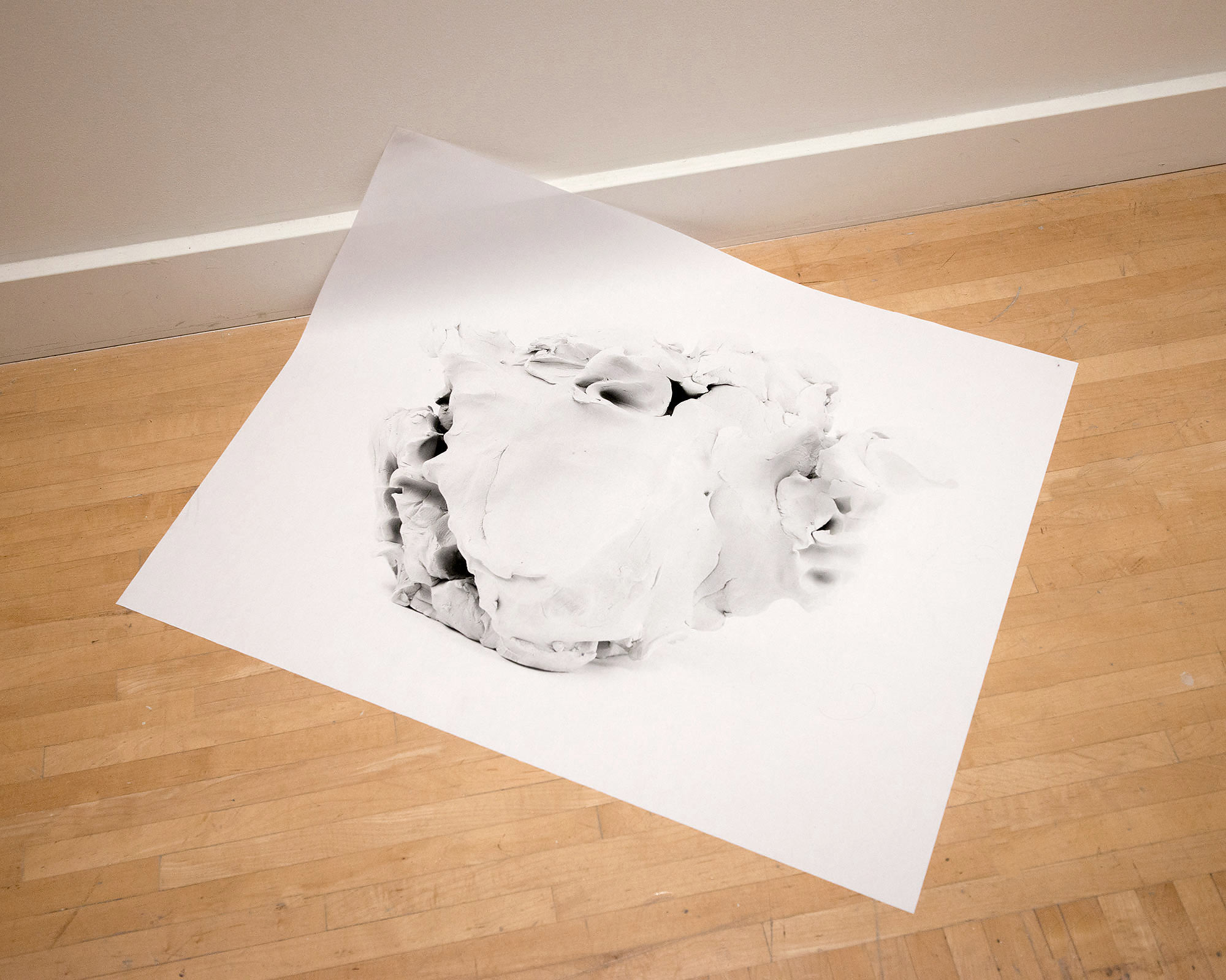
The Space Between Two People. 2013
Laser print of unfired clay pressed between two people. 28 x 36"
The Henry Art Gallery, Seattle, WA
Laser print of unfired clay pressed between two people. 28 x 36"
The Henry Art Gallery, Seattle, WA